Design Thinking is arguably one of the most influential frameworks of our times in terms of design and innovation. It’s a solution focused approach that prioritizes understanding users, redefining problems, and creating innovative solutions. With origins in various disciplines including engineering, psychology, and business, Design Thinking is now used across industries as a proven methodology to drive creativity and user centered innovation.
In this blog post, we’ll explore what Design Thinking is, why it’s effective, and how it can be applied. We'll also outline the steps in the Design Thinking process, its benefits, and why it’s a valuable approach for UI/UX designers and beyond.
What is Design Thinking?
Increasingly, businesses are applying Design Thinking to human-centered development and problem-solving with a focus on empathy, collaboration, and experimenting. It is quite a deviation from the traditional forms of problem-solving, based on linear logic rather than a non-linear process-oriented model, which includes knowing the user, ideas generation, and testing of solutions.
This is an adaptive and iterative approach in which designers test their assumptions, rethink strategies, and refine solutions until they find the best possible outcome. This enables designers to solve challenging problems through reframing them from a human perspective.
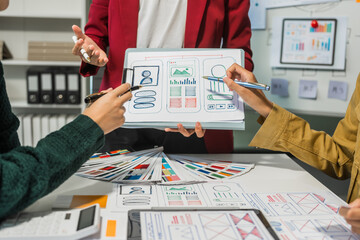
Why is Design Thinking Important?
Design Thinking is impactful for a variety of reasons:
- Encourages Empathy: When there is full understanding of users' needs and experience, designers come up with products that actually relate to people.
- Boosts Innovation: Design Thinking boosts innovation as it encourages "out-of-the-box" thinking and innovative solutions that can be more than ordinary ideas.
- Facilitates Collaboration: The process unites cross-functional teams, fosters a varying range of thoughts and opinions, and encourages mutual ownership of ideas.
- Promotes Agility: Design Thinking is iterative, allowing for constant improvement and adaptation based on real-time feedback and testing.
The Design Thinking Process: Step-by-Step
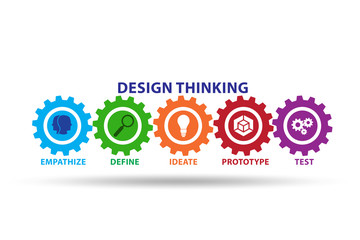
The process of Design Thinking usually comprises five stages, which can overlap and even be sequenced differently depending on the project. Here is a closer look at each stage:
1. Empathize - Understanding the User
The first empathetic practice of Design Thinking is the need to enter the user's world to deeply understand his pain points, needs, and motivations. Often, it becomes a process of:
- User Interviews: One to one direct conversations with users for insights into what is in demand.
- Observational Studies: Recording the behavior of a user in his own environment to determine how he uses similar products.
- Empathy Mapping: Creating illustrations of what people think, feel, say, and do to understand how far the user might be looking at things.
The goal is to gain a thorough understanding of the users and their context to inform the rest of the design process.
2. Define - Identifying the Problem
After gathering insights, the team defines a core problem to be solved. For this purpose, it is essential to summarize the results of the Empathise phase in the form of concise problem statements. A good problem statement is a critical guide for the design process.
Common techniques here include:
- Point of View Statements: A concise description of the user, their needs, and the impact of those needs.
- Problem Statements: A specific statement that outlines the design challenge.
Defining the problem accurately ensures that all ideas and solutions developed later are directly relevant to user needs.
3. Ideate - Generating Ideas
Since the team now has a defined problem, they are good at brainstorming ideas. Ideation is purely an exploration of possible solutions without filtering or judging, that is to say, without trying to abort or even judge any possibilities. This stage is usually high-energy and creative through the use of approaches such as:
- Brainstorming: Whenever ideas are freely brought forth by team members to generate the maximum number of ideas, no idea is dismissed.
- Mind Mapping: Organization of ideas visually to study linkages between them.
- SCAMPER Technique: Checklist which provokes creativity by brainstorming how to substitute, combine, adapt, modify, put to other uses, eliminate, or reverse elements of the problem.
The goal is to push beyond obvious solutions and discover innovative approaches.
4. Prototype - Bringing Ideas to Life
After generating potential solutions, it is time to build prototypes-in scaled-down versions or models of the product or feature that has been considered. Prototyping allows designers to test and experiment with ideas quickly without heavy investment.
Key practices in this stage include:
- Low-Fidelity Prototypes: Paper sketches or wire frames representing the idea in a simple form.
- Interactive Prototypes: Digital models that simulate user interactions.
- Rapid Prototyping: Creating and testing many prototypes as quickly as possible to see what will really work.
Prototyping allows designers to explore and refine ideas, discovering what resonates with users before further development.
5. Test - Gathering Feedback and Refining
The final stage of Design Thinking involves testing the prototypes with users. The insights gained from testing reveal what works, what doesn’t, and what can be improved. Testing often involves:
- User Testing: Observation of how real users interact with the prototype in order to see whether their needs have been met.
- Feedback Loops: When feedback from users is gathered to make an improved version of the product.
- Iteration: Change the prototype based on what is learned from testing it and test again if needed.
Testing is not the end of the process; rather, it is a phase that makes it necessary to return to earlier stages, such as reframing the problem or re-imagining potential solutions. This is an iterative cycle to provide users with a result that is as beneficial as feasible.
Benefits of Design Thinking
- Inspires Creativity and Innovation: Design thinking encourages designers to look above mundane ideas, resulting in creative and innovative solutions.
- Reduces Risk of Failure: By testing ideas early and iterating as per the feedback received, Design Thinking diminishes the risk of costly blunders or product failures.
- Builds Stronger Team Collaboration: Design Thinking brings people together, thereby tapping into multifaceted thinking and knowledge to better solve problems.
- Increases User Satisfaction: A product that is being designed with the needs of the user in mind will surely reach the user expectations leading to higher satisfaction and engagement.
How to Apply Design Thinking in UI/UX
In UI/UX design, Design Thinking is invaluable for creating user-centered interfaces and experiences. Here are practical ways to integrate it into your work:
- Empathy in Research: Take time to understand user personas and context. Observe how they interact with similar products and listen to their feedback.
- Define Pain Points: Clearly define what users struggle with and ensure that your design addresses those specific issues.
- Idea Generation: Include diverse teams to generate as many ideas as possible.
- Rapid Prototyping: Generate prototypes and test usability so that users can provide feedback before refining again.
- Continuous Testing: Regularly test designs with users, gather feedback, and make adjustments to improve usability and satisfaction.
Conclusion
Design thinking is a transformational way of solving some of the hardest problems with a user centric approach. It aligns with empathy, collaboration, and creativity to ensure products are functional, innovative, and highly aligned towards the users' needs. Its iterations processes minimize risk, while maximizing user satisfaction.
Design Thinking in UI/UX design helps teams produce not only beautiful but also highly functional and user-friendly products. As the design landscape continues to evolve, Design Thinking remains an essential tool for creating meaningful, impactful experiences that truly resonate with users.
Level up your UI/UX skills! Learn to create stunning interfaces and seamless user experiences with our Advanced UI/UX Design Course. Boost your career and design products that stand out.
Enroll today at Kaarwan for more insights!
FAQs
1. What is Design Thinking, and how does it differ from traditional design methods?
Design Thinking is a user-centered approach focused on empathy, creativity, and iteration. Unlike traditional design, it prioritizes understanding user needs and involves continuous testing and refining.
2. Why is empathy such an important part of Design Thinking?
Empathy helps designers see from the user's perspective, revealing insights that lead to solutions that genuinely meet users’ needs and expectations.
3. How do prototyping and testing fit into the Design Thinking process?
Prototyping creates a model to test ideas, and testing with users provides feedback to refine and improve designs, ensuring they work in real-life scenarios.
4. Can Design Thinking work for non-design fields too?
Absolutely! Design Thinking is used in business, healthcare, and more to solve problems innovatively and enhance user satisfaction.
5. What are some challenges teams face when implementing Design Thinking?
Challenges include overcoming traditional mindsets, dedicating time for testing, and managing the iterative process, but the benefits often outweigh these obstacles.